
Arkansas County Court Record Requests
Start with Search ARCourts. It can show you the public circuit case. You also get the case number, the court, and the filing title. From there, send your document request to the office that actually holds the file. Sarah Merchant, the Arkansas County Circuit Clerk, maintains Circuit Court records for the Northern and Southern districts. Those cover criminal, civil, domestic-relations, probate, and juvenile files. The District Court clerks in Stuttgart, DeWitt, Gillett, and St. Charles keep their own records. Those include traffic, minor criminal, small-claims, and limited civil matters.
You can reach Arkansas County court case records online. You can also use the right clerk counter, phone, fax, email, or mail. Call before mailing a written request. That way the district, fee, payment method, and delivery plan are all clear. The clerks make no promise of a public lobby terminal. So ask the court whether inspection or a terminal is offered. Another channel is the AOC compiled-data process, though it serves properly scoped data projects rather than one routine docket sheet.
- Find the case number, filing court, district, case type, entry title, and filing date.
- Choose a plain, certified, or exemplified copy and state the delivery method.
- Contact the correct clerk by phone, counter, fax, email, or mail.
- Ask for the total fee, accepted payment, turnaround, and any access limit.
- Submit the request with contact details and a maximum-cost instruction.
Arkansas County’s Two Record Counters
Two counters serve the county. The Northern District Circuit Clerk sits at 302 South College, Stuttgart, AR 72160. Call 870-659-2098 extension 1 or fax 870-659-2081. The Southern District counter is at 101 Court Square, DeWitt, AR 72042. Call 870-659-2099 extension 1 or fax 870-659-2092. For procedure questions, the clerk site publishes sarah.merchant@leo.gov. Know your filing district before you travel or mail funds. The two record locations are not interchangeable by default.
The Arkansas Judiciary circuit-clerk directory is the statewide clerk source.
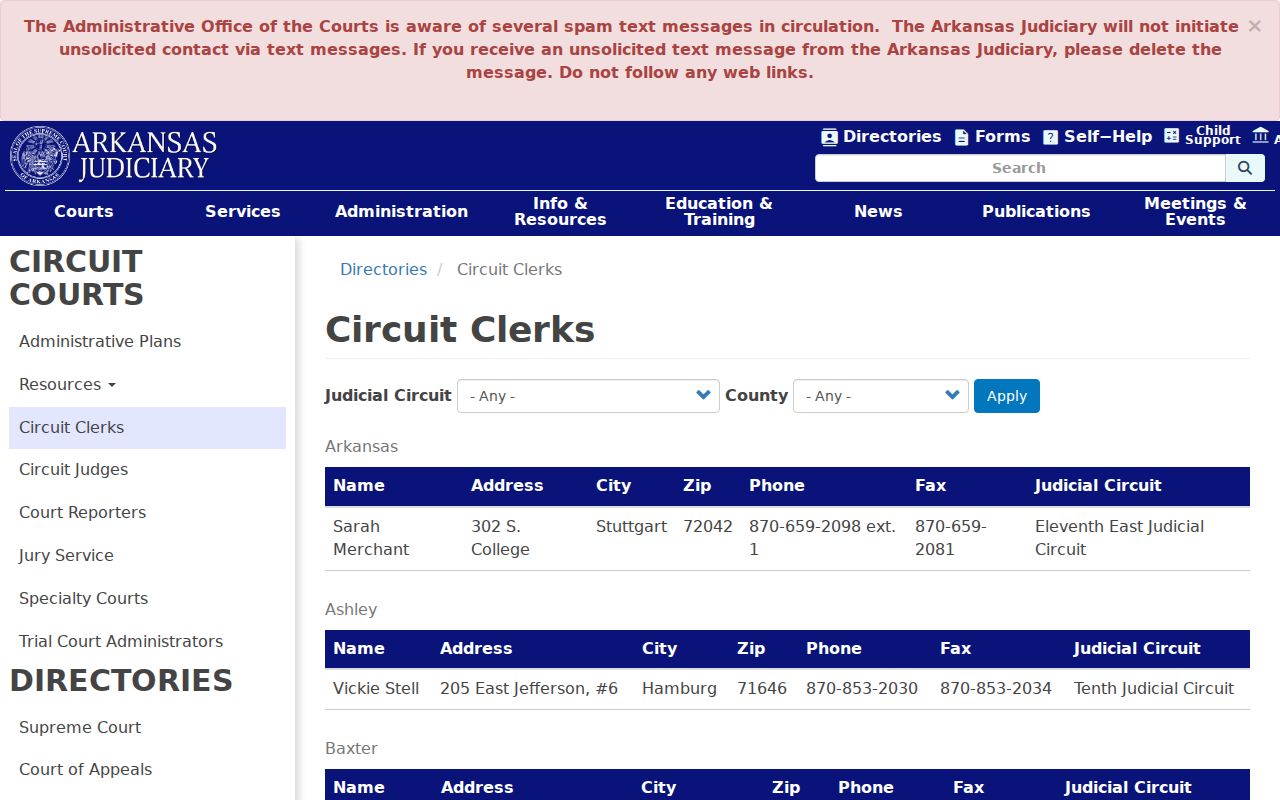
The directory anchors the request to the Circuit Clerk, not the separate County Clerk.
Arkansas County Circuit Clerk
Northern District: 302 South College, Stuttgart, AR 72160
870-659-2098 ext. 1 | Fax 870-659-2081
Southern District: 101 Court Square, DeWitt, AR 72042
870-659-2099 ext. 1 | Fax 870-659-2092
Kinds of Court Records
A docket is the chronological index. The full Arkansas County court record may include the papers and orders listed behind it. Circuit case types cover felony, major civil, domestic-relations, probate, and juvenile matters, subject to public-access limits. District Court files can include traffic, misdemeanor, ordinance, small-claims, and limited civil matters. These are assigned to that department. Match the record type first. It tells you which office holds the file. It also shows what details make the request useful.
- Docket sheets and case-history printouts
- Complaints, petitions, criminal informations, answers, and motions
- Notices, returns, settings, continuances, and other filed entries
- Orders, judgments, dispositions, and sentencing documents
- Plain, certified, or exemplified clerk copies
- Historic indexes, volumes, and archival courthouse records
Transcripts come from court reporters and may need separate ordering and payment. Exhibits can carry special custody, format, or protective-order limits. Neither follows the same path as a standard clerk paper. The Judiciary’s Sarah Merchant entry identifies the current Circuit Clerk.
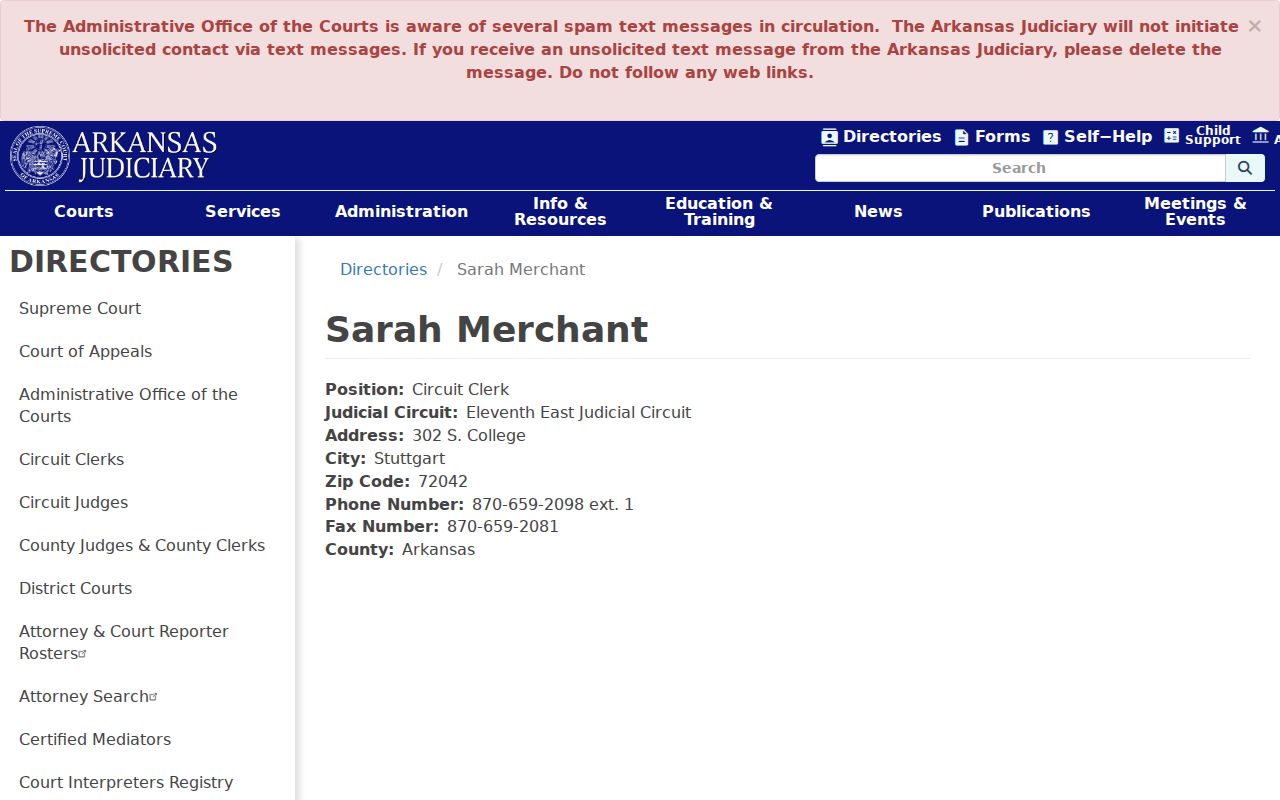
That public-capacity entry helps confirm the official custodian before a copy request is sent.
Arkansas County’s Three Record Layers
Three layers matter here. Search ARCourts offers free docket or case information. It includes an index and event chronology when public data is available. A filed document is the complaint, motion, order, judgment, or other paper behind an entry. A certified copy is a clerk-authenticated reproduction. A browser printout may help you track an Arkansas County court case. It does not become certified just because it displays official-system data.
| Layer | What it provides | Best route |
|---|---|---|
| Docket or case information | Header, parties, events, filings, status, and future settings | Search ARCourts, then verify with court |
| Filed document | The actual public paper behind a docket entry | Portal link when available or clerk request |
| Certified copy | Clerk-authenticated reproduction | Record-holding clerk after fee quote |
A missing document link proves nothing. The filing may not be digitized, may not be attached to the public entry, or may carry an access limit. Sealed is not the automatic answer. Give the clerk the case number, entry date, and exact title. Then staff can locate the paper. The Circuit judge directory shows the judicial division context for Arkansas County.
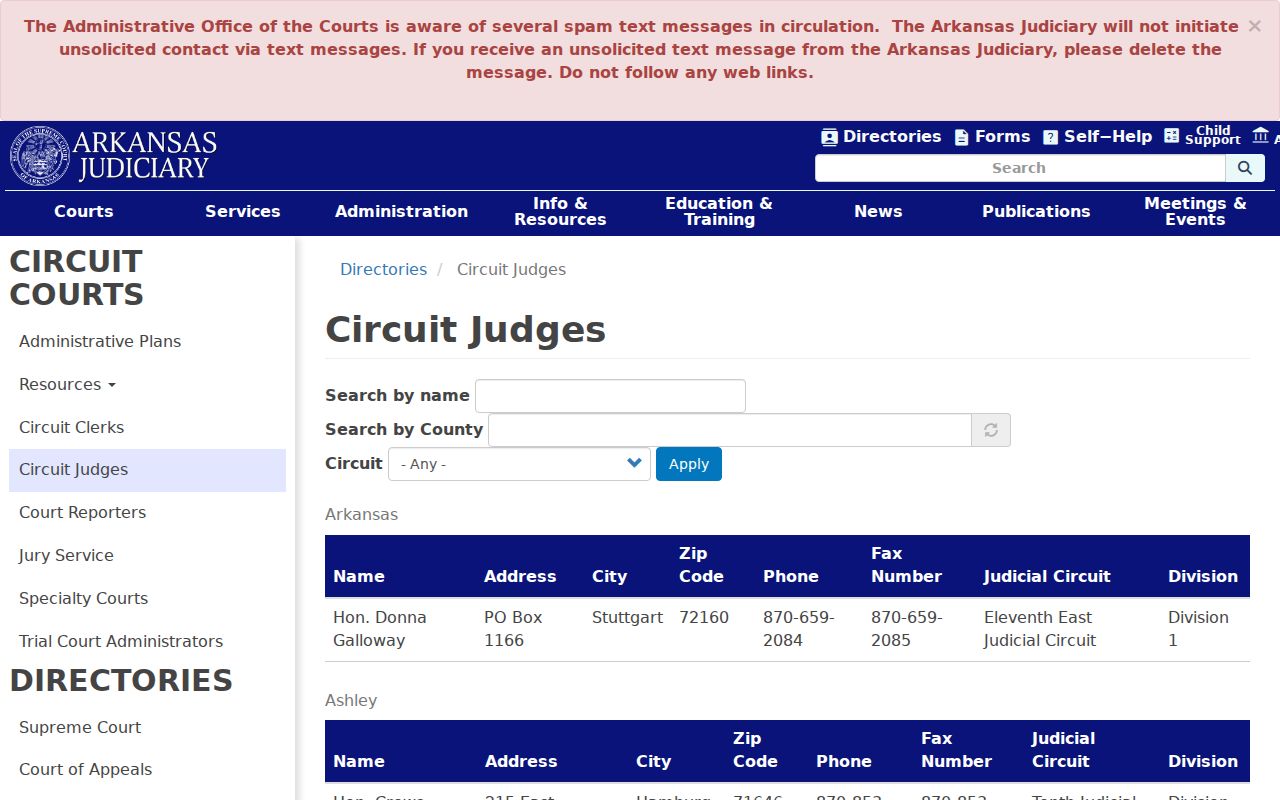
The judge directory identifies the court division; copy custody still belongs with the clerk.
Court Records: What They Contain
Every Arkansas County court record opens with its court identity and case number. From there it may list parties or participants, attorneys, filing dates, case type, status, judge, chronological filings, hearings, orders, disposition, and judgment. Criminal matters can add charge, statute, plea, sentence, and disposition entries. Civil records can add claims, service, answers, motions, judgments, and post-judgment work. Content depends on two things. It turns on what was filed and what public-access rules permit.
| Header | Case number, court, case type, filing date, status, and assigned judge. |
|---|---|
| Participants | Public party roles, names, and attorneys when entered. |
| Chronology | Filed papers, court events, settings, and later orders in date order. |
| Outcome | Disposition or judgment and its date when entered. |
| Document access | Public links where available, or a clerk request for the named paper. |
| Restriction markers | Redaction, confidentiality, protective-order, or sealed status indicators. |
The docket is not a transcript. It may not hold all evidence. A “Motion filed” entry does not mean “motion granted”; a later order controls that point. In the same way, a future event is only a planned setting, not proof the hearing occurred. The District Court directory identifies Arkansas County’s lower-court clerks.
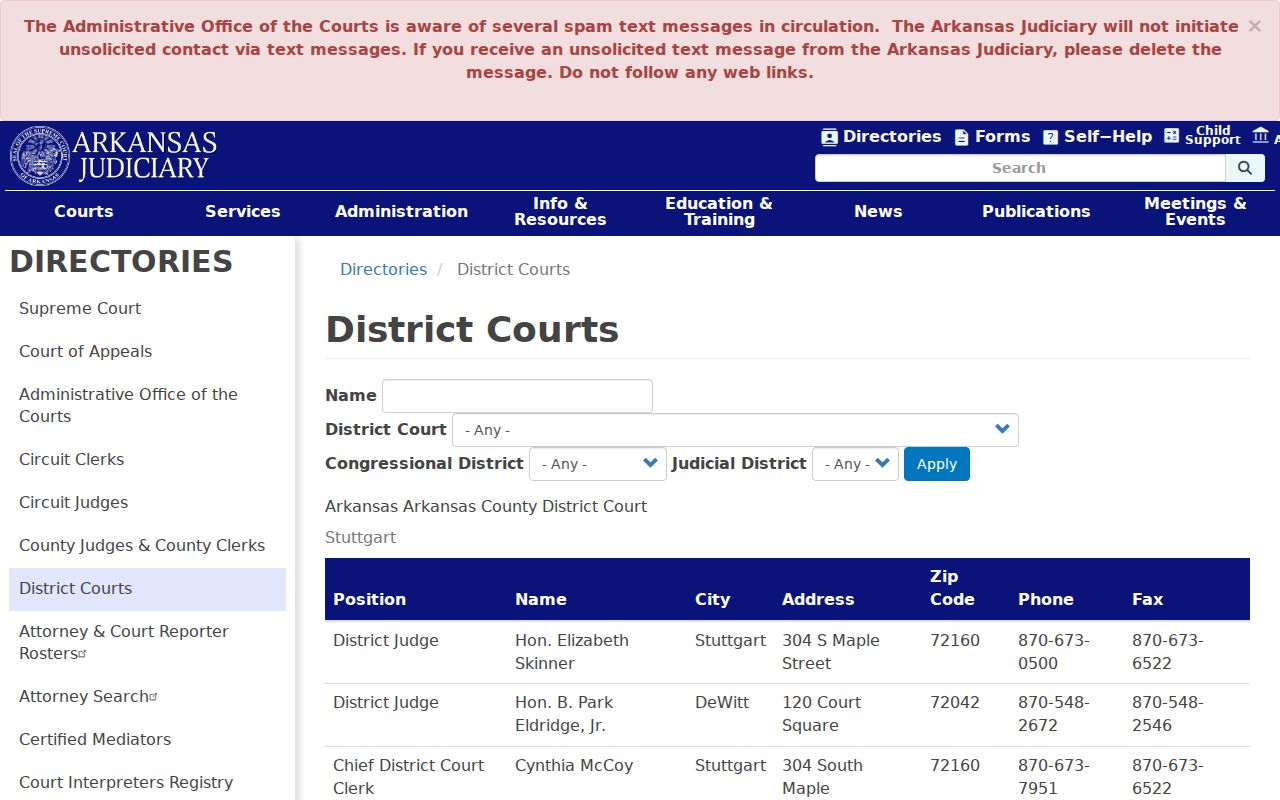
This directory is the correct starting point when a traffic or minor case sits outside the Circuit Clerk’s files. Let it guide you to the right lower-court office.
Arkansas County Written Request Details
A precise request saves everyone time. Name the court and district. Give the exact case number, the case type, the document title, and the filing date if you know it. Say whether the copy should be plain, certified, or exemplified, and add your delivery choice plus a phone or email for questions. Include the most you authorize the clerk to charge without a new quote. Never mail a guessed payment. Let the office confirm the amount and the accepted form first.
For broad case information stored on AOC computers, use the data-request process.
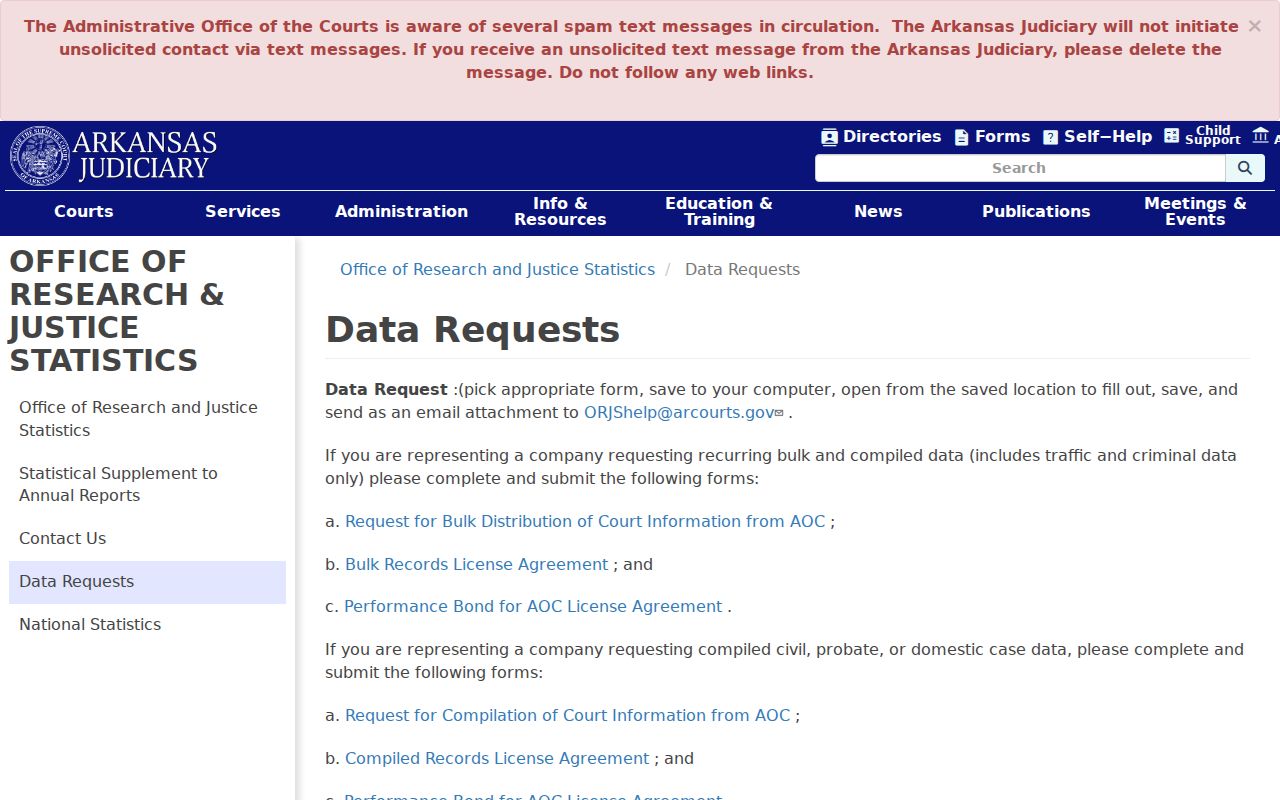
The data-request page draws a sharp line between two things. One is compiled statewide information. The other is a plain copy of one case. If a request asks for identifiable or normally excluded information, expect an affidavit, two license agreements, and a performance bond. Even that heavier process cannot unseal an Arkansas County case.
The form itself wants detail. List the requester, organization, address, telephone, email, and purpose. Add a fee-waiver explanation if one is sought, then sign and date it. For ordinary filed documents, the request still goes to the court that holds the record.
Copy Fees and Certification
The clerk publishes no local price list for a plain copy, certified copy, exemplified copy, docket sheet, or clerk search. Say that plainly. Before sending money, ask the correct clerk for a current quote, accepted payment methods, mailing terms, and turnaround. Certification means the clerk produced the copy and authenticated it. It says nothing about whether the source record itself is open to you.
| Item | Verified amount |
|---|---|
| Online docket or case information | Free public search |
| Linked public document | No portal price stated; availability varies |
| Plain clerk copy | Not published in reviewed official sources |
| Certified copy | Not published in reviewed official sources |
| Exemplified copy | Not published in reviewed official sources |
| Docket sheet or clerk research | Not published in reviewed official sources |
Payment never converts a restricted record into an available one. Access comes from law or a court order, not from a receipt. The county sets no standard ID rule or fixed turnaround for ordinary public records.
For current court paperwork, the Arkansas Judiciary forms index collects official court forms in one place.
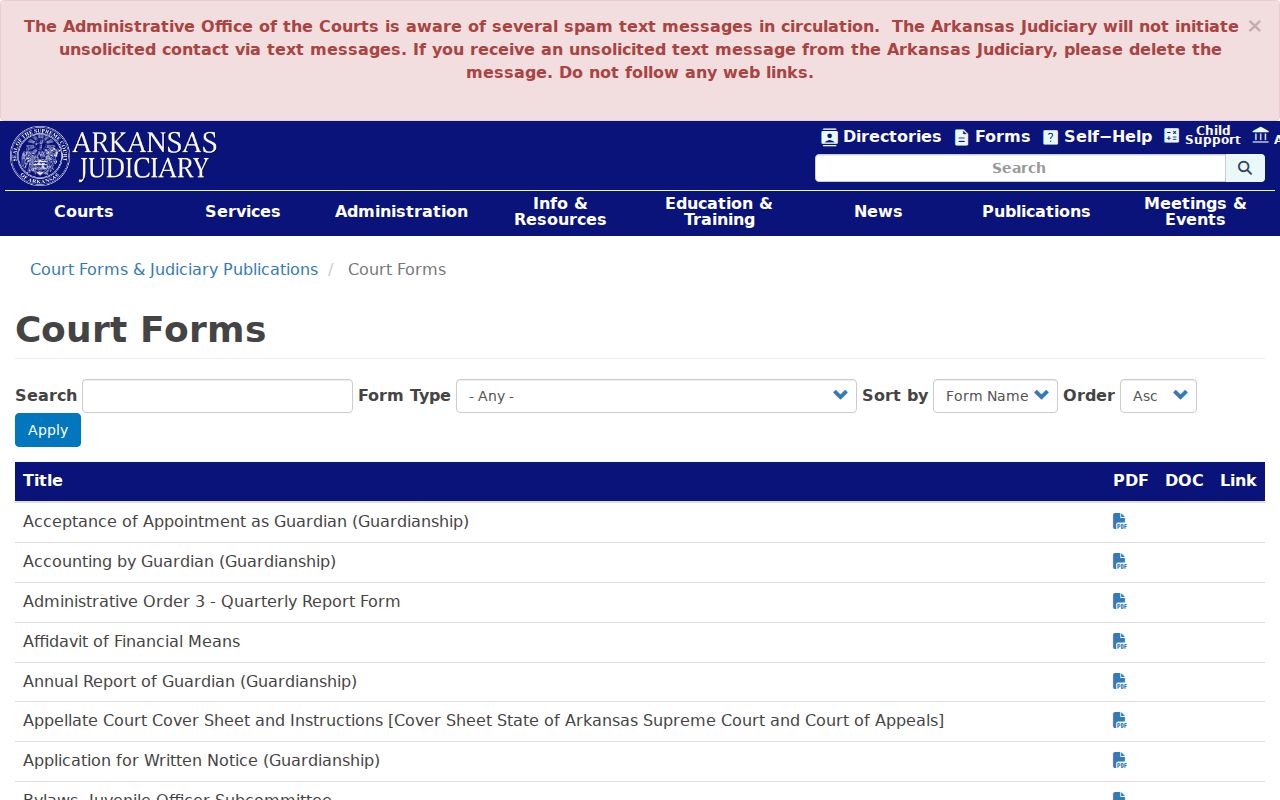
Handy as it is for current court paperwork, the forms index is not a posted local fee schedule.
Arkansas County Records Since 1796
Arkansas County keeps its oldest records at DeWitt, and they date to 1796. Some are written in Spanish, the Circuit Clerk reports. So historic court research may mean bound books, old indexes, and staff help rather than a Search ARCourts result. Ask the Southern District office which index covers the name, land, estate, or proceeding. Also ask whether the volume can be inspected and what reproduction limits apply. Never assume an old public record has a scanned image.
The two courthouses also reflect different custody paths. Both entered the National Register in 1992. DeWitt's courthouse dates to 1931, and Stuttgart's was built in 1928. Preservation protects the buildings, but it does not by itself change online record access. The practical point is narrower. Don't send a Northern District caption to DeWitt without confirmation. And tailor any request for the Southern District's archival holdings to older formats.
Note: Historic Arkansas County court records may require index assistance and careful handling. Even then, the underlying material can be public.
Access Rules for Court Records
Administrative Order 19 is the main Arkansas court-record access rule. The Arkansas Freedom of Information Act governs many government records. Judicial case-record access, though, runs through Supreme Court authority and AO 19. Under Administrative Order 19.1, confidential information must be removed from the public version. An unredacted version is filed under seal when required.
Social Security numbers are protected. So are account numbers, material sealed by court order, and information made confidential by statute. These stay closed even though the case has a docket. Arkansas law closes juvenile records. Adoption or protected family records can be closed or limited. A public file may show "[Information Redacted]," "[I.R.," "[Confidential]," or "[Subject To Protective Order]." An entirely redacted document may still list its name and page count. That holds unless the law protects the record's very existence.
Public does not always mean online. An Arkansas County paper may be open for courthouse inspection but absent from the portal. Ask the filing clerk about the specific entry and lawful access route.
The Office of Research and Justice Statistics explains the state’s data function and custody.
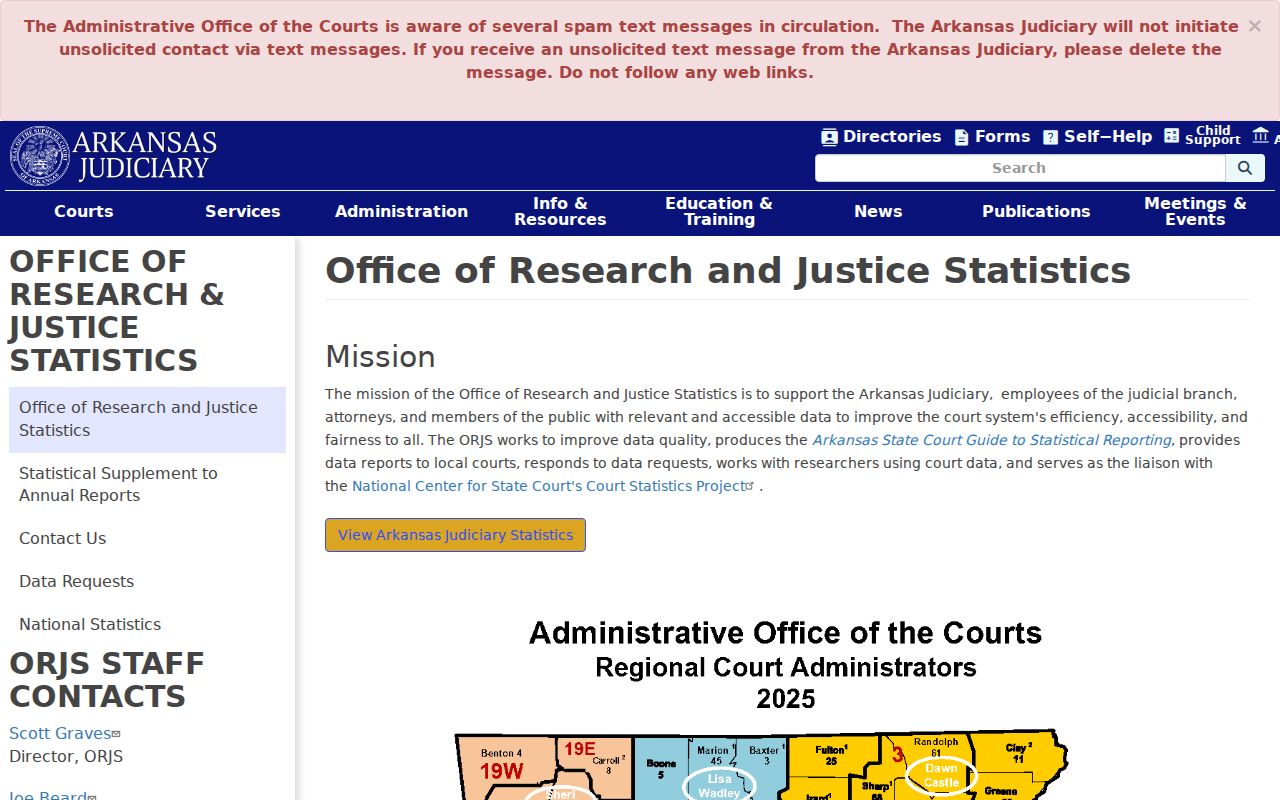
That official page marks the compiled-data channel. It is no replacement for the Arkansas County clerk's single-case records service.
Arkansas County Sealed Record Steps
A failed docket search can mean the wrong court. It can also mean the wrong district, a spelling error, an older nondigitized index, delayed entry, or lawful restriction. It does not prove no record exists. Criminal sealing under Arkansas law limits ordinary disclosure. Still, it gives a public portal user no right to demand hidden data. Juvenile confidentiality and recent changes to expungement timing also need case-specific review. Adoption records must be closed, subject to limited legal exceptions.
For restricted material, contact the filing clerk. Identify the case without exposing sensitive facts in ordinary email. Explain your role, and ask what statute, authorization, or court order applies. Anyone seeking sealing should use current Judiciary forms and legal requirements. No county-specific filing fee is posted, so assume no amount.
Transcripts and exhibits need their own custody check. Court reporters produce the transcripts. Exhibits may sit in a special format or under a protective order. The clean first step is requesting the docket entry by title and date. Then follow the holder's direction for the actual material.